- Where else amount in words is used
- Why Indian banking still uses Lakh/Crore
- Worked examples at different amounts
- Why the amount in words matters
- The correct cheque format
- Indian vs. International number format
- Using amount in words on GST invoices
- Writing paise correctly
- Common mistakes that get cheques rejected
- Step-by-step: convert any amount instantly
- Frequently asked questions
Getting the amount-in-words line wrong on a cheque is one of the most common reasons banks reject payments. This guide covers the correct format to use in the Indian Lakh/Crore system, how paise should be written, why GST invoices commonly include the same convention even though it isn't always mandatory, and a free tool that does the conversion instantly — along with a few real worked examples so the pattern is easy to apply without memorizing the rule.
Where else amount in words is used
Cheques are the most familiar case, but the same convention shows up across several other financial documents in India, and the format expectations are largely the same in each:
| Document | Why amount in words is used |
|---|---|
| Promissory notes | Legally binding loan acknowledgments where the words act as the authoritative amount if figures are disputed |
| Rent receipts | Confirms the exact rent paid, reducing later disputes over the amount between tenant and landlord |
| Salary slips | Some employers spell out the net payable amount in words alongside the figure for clarity |
| Demand drafts | Follows the same figures-plus-words convention as cheques, issued by the bank itself |
| Legal affidavits | Monetary claims or settlements are often written in words to avoid any ambiguity in a legal filing |
In each of these cases, the underlying reasoning is identical to the cheque scenario: numbers are easy to misread, mistype, or alter, while words spelled out in full are far more resistant to accidental or intentional error — which is why the same convention has persisted across so many different document types rather than being unique to cheques.
Why Indian banking still uses Lakh/Crore
The Lakh/Crore system groups digits differently from the International system — after the first three digits from the right, Indian format groups in pairs of two (1,00,000) rather than groups of three (100,000). This isn't just a stylistic difference; it reflects how large numbers have traditionally been spoken and written across the subcontinent for centuries, well before modern banking existed. Because this convention predates and remains independent of the International system, Indian financial institutions, tax authorities, and most everyday commerce continue to use Lakh and Crore rather than switching to Million and Billion, even as international business increasingly uses the latter.
This is also why templates, invoice software, and cheque-writing guides built for an Indian audience default to Lakh/Crore — switching to Million/Billion without a clear reason can look unfamiliar or even suspicious to a bank clerk or accountant used to seeing the local convention on every other cheque that crosses their desk.
Worked examples at different amounts
Seeing the format applied across a few different amounts makes the pattern easier to internalize than the rule alone:
| Amount in figures | Amount in words |
|---|---|
| ₹5,500.00 | Five Thousand Five Hundred Rupees Only |
| ₹42,000.25 | Forty-Two Thousand Rupees and Twenty-Five Paise Only |
| ₹3,50,000.00 | Three Lakh Fifty Thousand Rupees Only |
| ₹27,80,000.00 | Twenty-Seven Lakh Eighty Thousand Rupees Only |
| ₹1,05,00,000.00 | One Crore Five Lakh Rupees Only |
Notice that the comma placement itself follows the Indian grouping convention (2,2,3 digits from the right, as in 1,05,00,000) rather than the International 3-digit grouping (105,000,000) — another detail that's easy to get subtly wrong when switching between formats for different clients.
Why the amount in words matters
Every cheque and most formal invoices require the amount to appear twice: once in figures, once spelled out in words. This isn't just a formality — it's a fraud-prevention measure. Numeric figures can be altered with a stray pen stroke (turning a 1 into a 4, for example), but words are far harder to tamper with. If the figures and words don't match, banks are required to reject the cheque, so getting this line exactly right matters every single time, not just for large amounts.
The correct cheque format
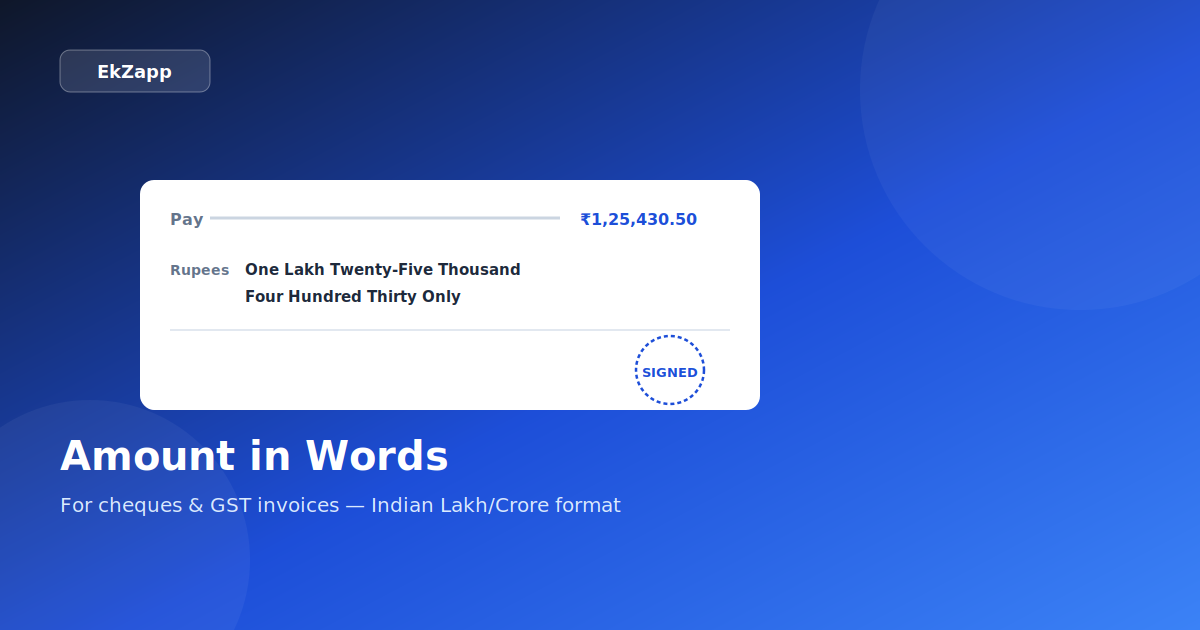
Amount in figures: ₹1,25,430.50
Amount in words: One Lakh Twenty-Five Thousand Four Hundred Thirty Rupees and Fifty Paise Only
Notice three things about this format:
- It uses the Indian numbering system (Lakh, Crore) rather than the International system (Million, Billion).
- Paise are spelled out separately after "and."
- The word "Only" appears at the end — this closes the line so nothing can be added afterward.
This exact structure — figure, then words, then "Only" — is what bank clerks and accounts staff are trained to scan for at a glance, so deviating from it (even with a technically correct amount) can slow down processing or trigger extra manual verification.
Indian vs. International number format
| Value | Indian Format | International Format |
|---|---|---|
| 1,00,000 | One Lakh | One Hundred Thousand |
| 10,00,000 | Ten Lakh | One Million |
| 1,00,00,000 | One Crore | Ten Million |
Indian banks and most GST invoices expect the Lakh/Crore format. If you're dealing with international clients, you may need the Million/Billion format instead, so it's worth confirming which convention the recipient expects before finalizing a large invoice — a foreign client unfamiliar with "Lakh" may misread the actual amount entirely, which defeats the purpose of writing it out for clarity in the first place.
Using amount in words on GST invoices
While not strictly mandatory under GST rules, spelling out the total amount in words on an invoice is standard business practice in India. It reduces disputes, helps with manual verification during audits, and looks more professional to clients — especially for high-value invoices where a numeric-only total can be easier to misread or mistype during data entry on the recipient's end.
This matters more in a business context than it might first appear: an invoice is often processed by several different people across two organizations — the person who raises it, an accounts team that books it, and possibly an auditor reviewing it months later. A words line gives every one of those readers an unambiguous cross-check against the numeric total, the same fraud-prevention logic that applies to cheques, just applied to a commercial document instead of a payment instrument.
Writing paise correctly
Paise trip people up more often than the rupee amount itself, since the exact phrasing varies slightly depending on whether there's a rupee component at all, and getting this detail wrong is a common source of small, avoidable mismatches:
Common mistakes that get cheques rejected
- Forgetting "Only" at the end — this leaves room for the line to be extended, which is exactly what banks are guarding against.
- Mixing Indian and International formats — writing "One Million" on a cheque meant for an Indian bank reads unusually and can raise a verification flag even if the number itself is correct.
- Leaving a gap after the words — a large empty space before "Only" (or after it, before the edge of the line) can be a place for unauthorized additions; the line should be filled or closed off.
- Mismatched figures and words — even a small typo, like writing "Fourty" thousand in words while the figure says 4,000, causes an automatic mismatch rejection.
- Inconsistent handwriting on physical cheques — rushed or unclear handwriting on the words line can be misread by bank staff even when the intended amount is correct, so writing (or printing, where allowed) clearly matters as much as getting the wording right.
- Using abbreviations in the words line — writing "1 Lac 25 K" instead of spelling the amount out fully defeats the purpose of the words line as a fraud check and is typically not accepted.
Step-by-step: convert any amount instantly
- Open the Amount in Words Converter on EkZapp.
- Type the number, including paise if needed (e.g., 125430.50).
- Choose Indian (Lakh/Crore) or International (Million) format.
- Copy the result directly onto your cheque or invoice.
Frequently asked questions
Why do cheques need the amount written in words?
Banks require the amount in both figures and words as a fraud-prevention measure. If the numeric amount is altered, the written words act as the legally binding cross-check, so any mismatch causes the cheque to be rejected.
What is the difference between Indian and International number format?
Indian format groups numbers using Lakh and Crore (1,00,000 = One Lakh), while International format uses Thousand, Million, and Billion. Indian banks and GST invoices typically use the Lakh/Crore format.
Should I add "Only" at the end of a cheque amount?
Yes. Adding "Only" after the amount in words is standard banking practice — it closes the line and prevents anyone from adding extra words to alter the amount.
Do GST invoices legally require the amount in words?
Not always mandatory under GST rules, but including the total in words is considered best practice for clarity and is commonly expected by clients and auditors, especially for larger transactions.
What happens if the figures and words on a cheque don't match?
Banks are required to reject a cheque when the numeric figure and the written words don't agree, since the mismatch could indicate either an error or an attempted alteration. The cheque is typically returned unpaid rather than processed with one version assumed correct.
How do I write paise in the amount-in-words line?
Paise are spelled out after the rupee amount, connected with "and" — for example, ₹1,250.75 becomes "One Thousand Two Hundred Fifty Rupees and Seventy-Five Paise Only."
Is there a standard way to write zero rupees and only paise?
Yes — when the amount is purely paise with no rupee component, it's written directly as the paise value followed by "Paise Only," without a "Zero Rupees" prefix, though conventions can vary slightly by bank.
Quick recap
The safe format for any Indian cheque or GST invoice is the Lakh/Crore system, paise spelled out after "and," and the line closed with "Only." Getting any part of this wrong — mismatched figures and words, a missing "Only," or the wrong number system — is one of the most common reasons a cheque bounces at the bank counter rather than a signature or date issue, and it's just as easily avoided once the pattern is familiar. The Amount in Words Converter handles the formatting automatically in either Indian or International style, so the line can be copied straight onto the document without manual spelling, whether it's a cheque, a promissory note, or a GST invoice heading to a client's accounts team.