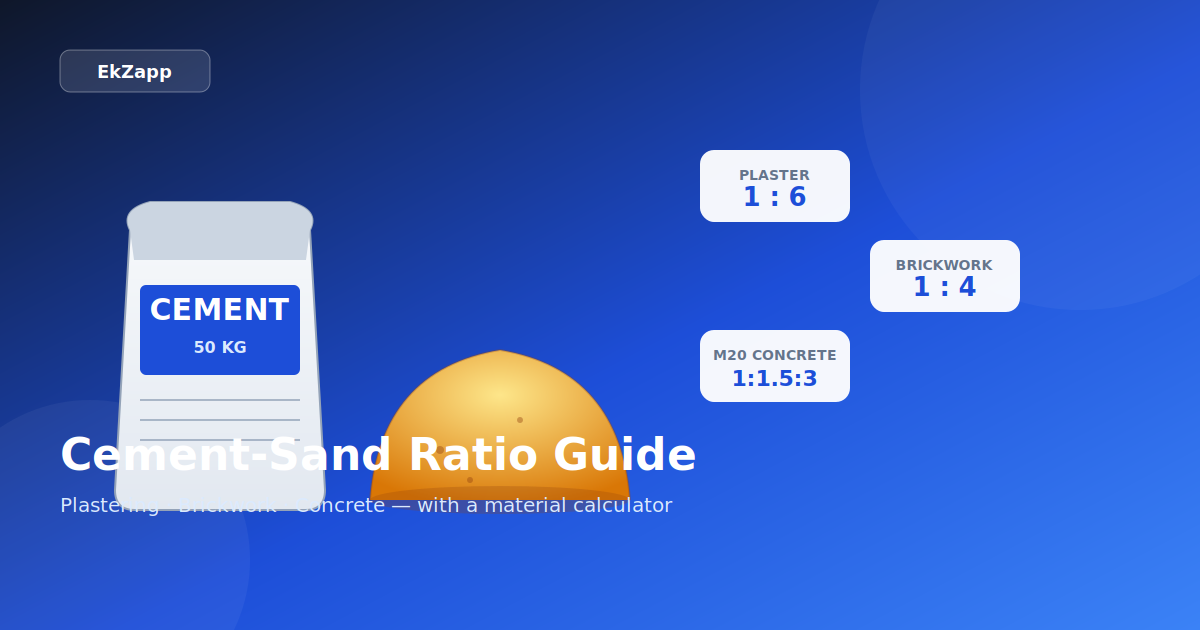
Every plastering job, brick wall, and concrete slab starts with the same question: how much cement and sand do you actually need? Get the ratio wrong and you either waste money on excess cement or end up with a weak, crack-prone mix. The ratios themselves are well established by CPWD and IS 456 specifications, but the part most people skip — converting a measured wall area into an actual shopping list of bags and CFT — is where most estimation errors happen. This guide covers both, plus a calculator below so you don't have to do the arithmetic by hand.
🧮 Instant plaster/brickwork material calculator
Enter your wall area, plaster thickness, and mix ratio — get cement bags and sand CFT instantly (dry volume factor already applied).
Cement-sand ratio for plastering
Plastering ratio depends on which surface you're covering and how much exposure it gets. A richer mix (more cement relative to sand) resists cracking and weathering better, but is also more prone to shrinkage cracks if used where it isn't needed — which is why the ratio changes by application rather than using one mix everywhere.
| Application | Ratio (cement:sand) | Typical thickness |
|---|---|---|
| Internal wall plastering | 1:6 (1:5 with coarser sand) | 12-15 mm |
| External wall plastering | 1:4 | 15-20 mm |
| Ceiling plastering | 1:3 to 1:4 | 6-8 mm |
| Repair / patch plastering | 1:3 | As needed to match surrounding surface |
The CPWD Specifications lay out a two-coat approach for many external and high-quality finishes: a coarser undercoat mix followed by a finer, richer top coat — which is why you'll sometimes see two ratios quoted for the same wall rather than one. External plaster also runs thicker than internal plaster since it has to withstand rain and temperature swings that an indoor wall never experiences.
Cement-sand ratio for brickwork
Brickwork mortar follows a similar logic to plastering — richer for exterior and load-bearing walls, leaner for interior partitions.
| Wall type | Ratio (cement:sand) |
|---|---|
| Load-bearing / external wall (9" brick wall) | 1:4 |
| Internal partition wall (4" brick wall) | 1:6 |
| General masonry / non-critical work | 1:5 |
A 1:4 mix has more cement per unit of sand, which increases bonding strength — appropriate for walls actually carrying structural load. A 1:6 mix is leaner and cheaper, and is normally sufficient for internal walls that only need to divide space, not bear weight.
Concrete nominal mix ratios (M10-M25)
Concrete ratios are standardized differently from mortar — they're written as three numbers (cement : sand : aggregate) and tied to a strength grade defined by IS 456. The "M" stands for "Mix" and the number is the characteristic compressive strength in N/mm² (MPa) after 28 days of curing.
| Grade | Ratio (cement:sand:aggregate) | Typical use |
|---|---|---|
| M10 | 1:3:6 | Non-structural: leveling courses, pathways, base layers |
| M15 | 1:2:4 | Plain concrete: flooring, small foundations, PCC work |
| M20 | 1:1.5:3 | Minimum for structural RCC: slabs, beams, columns |
| M25 | ~1:1:2 (design mix) | Higher floors, heavier loads — lab-tested proportions |
Why dry volume is more than wet volume
This is the step most manual calculations get wrong. When you measure a wall's area and plaster thickness, you get the wet volume — the volume of the finished, set mortar. But dry cement and sand, before water is added, are loosely packed with air voids between the particles. Adding water fills those voids and compacts the mix, which is why the finished wet volume ends up smaller than the dry material you started with.
To buy the right amount of material, you have to work backwards from wet volume to dry volume using a standard multiplying factor:
- Mortar (plastering, brickwork): Dry volume = Wet volume × 1.33
- Concrete: Dry volume = Wet volume × 1.54
The factor is higher for concrete because it accounts for voids between both fine and coarse aggregate, whereas mortar only has fine aggregate (sand) to compact. Skipping this step is the single most common reason people run short of material mid-job and have to make an emergency second trip for more cement or sand.
Worked example: 100 sq ft of plastering
Say you're plastering 100 sq ft of internal wall at the standard 12 mm thickness, using a 1:6 ratio.
| Step | Calculation | Result |
|---|---|---|
| Wet volume | 100 sq ft × 0.0394 ft (12 mm) | 3.94 CFT |
| Dry volume | 3.94 × 1.33 | 5.24 CFT |
| Total ratio parts | 1 + 6 | 7 |
| Cement volume | 5.24 ÷ 7 | ≈ 0.75 CFT |
| Cement in bags | 0.75 ÷ 1.25 CFT per bag | ≈ 0.6 bag |
| Sand volume | 5.24 × 6 ÷ 7 | ≈ 4.49 CFT |
So for a single 100 sq ft wall, you'd need roughly half a bag of cement and about 4.5 CFT of sand — before adding a 5-10% wastage margin. Scale this up across an entire house and the sand quantity adds up fast, which is exactly where converting CFT into trolley loads and a cost estimate becomes useful rather than doing it by hand for every wall.
Worked example: a small concrete slab
Now say you're casting a 100 sq ft slab at 4 inches (0.333 ft) thickness, using M20 (1:1.5:3).
| Step | Calculation | Result |
|---|---|---|
| Wet volume | 100 sq ft × 0.333 ft | 33.3 CFT |
| Dry volume | 33.3 × 1.54 | ≈ 51.3 CFT |
| Total ratio parts | 1 + 1.5 + 3 | 5.5 |
| Cement volume | 51.3 ÷ 5.5 | ≈ 9.3 CFT (≈ 7.5 bags) |
| Sand volume | 51.3 × 1.5 ÷ 5.5 | ≈ 14 CFT |
| Aggregate volume | 51.3 × 3 ÷ 5.5 | ≈ 28 CFT |
These are theoretical quantities from the formula — actual site orders typically add a wastage margin on top, and for anything beyond a small slab or footing, it's worth having a structural engineer confirm the grade and reinforcement rather than relying on a nominal mix alone.
Common estimation mistakes
- Skipping the dry volume factor entirely — using wet volume directly against the ratio understates material needed by roughly a third for mortar and over half for concrete.
- Using the wrong dry volume factor — applying concrete's 1.54 to a mortar calculation (or vice versa) skews the result meaningfully in either direction.
- Treating M15 as strong enough for RCC work — it's a plain-concrete grade, not meant for reinforced structural elements.
- Not adding a wastage margin — real-world spillage, over-thickness application by masons, and measurement rounding typically add up to another 5-10% on top of the calculated figure.
- Assuming sand type changes the ratio — river sand and M-sand use the same ratio; what differs is workability and price per CFT, not the mix proportion itself.
Frequently asked questions
What is the standard cement-sand ratio for plastering?
Internal wall plastering typically uses 1:6 (1 part cement, 6 parts sand) with fine sand. External wall plastering uses a richer 1:4 mix since it faces rain and temperature swings, and ceiling plastering uses 1:3 or 1:4 for stronger adhesion overhead.
What is the cement-sand ratio for brickwork?
Brickwork mortar generally ranges from 1:4 to 1:6. A 1:4 mix is common for load-bearing or external walls, while 1:6 is typically used for internal, non-load-bearing partition walls.
What is the difference between M15, M20, and M25 concrete?
These are nominal mix ratios defined by IS 456: M15 is 1:2:4 (cement:sand:aggregate) and used for plain concrete like flooring or leveling; M20 is 1:1.5:3, the minimum typically used for structural RCC elements like slabs and beams in residential buildings; M25 is generally a design mix (commonly approximated as 1:1:2) used for higher floors or heavier loads.
Why do I need more dry material than the wet volume I calculated?
Dry cement and sand contain air voids between particles. When water is added, these voids get filled and the mix compacts, so the wet (finished) volume ends up smaller than the dry material you started with. To buy enough material, multiply your wet volume by 1.33 for mortar (plastering, brickwork) or 1.54 for concrete before applying the mix ratio.
How much cement and sand do I need for 100 sq ft of plastering?
For 100 sq ft at 12 mm thickness with a 1:6 ratio, the wet volume is about 3.94 CFT. After applying the 1.33 dry volume factor, that's roughly 5.24 CFT of dry mix, which works out to about 0.75 CFT of cement (roughly half a 50 kg bag) and about 4.5 CFT of sand.
How many CFT of sand equal one cement bag by volume?
One 50 kg cement bag is approximately 1.25 CFT in volume. The sand-to-cement CFT ratio then follows directly from your mix ratio — for a 1:6 mix, you'd need roughly 6 times 1.25 CFT, or about 7.5 CFT of sand, per bag of cement, before accounting for the dry volume factor.
Does the cement-sand ratio change based on the type of sand?
The ratio itself doesn't change based on whether you use river sand or M-sand (manufactured sand) — a 1:6 mix stays 1:6 regardless. What can differ is workability and finish quality, and some sites adjust the ratio slightly finer (e.g. 1:5 instead of 1:6) when using coarser sand.
Can I use M15 concrete for a house slab or column?
No. M15 (1:2:4) is a nominal mix intended for plain, non-structural concrete like flooring, leveling courses, or foundations without reinforcement. Reinforced structural elements like slabs, beams, and columns in residential construction require a minimum of M20 (1:1.5:3) as per IS 456, and higher grades for taller or heavier-loaded structures.
Why does my actual material usage differ from the calculated estimate?
Calculated quantities are theoretical estimates. Real usage varies with wastage during handling, over-thickness applied by masons, moisture content of sand, and site-specific practices, so it's common to add a 5-10% safety margin on top of the calculated quantity for a real order.
Quick recap
Plastering ratios run from 1:3 (ceiling, repair) to 1:6 (internal walls), brickwork from 1:4 to 1:6, and concrete follows fixed nominal ratios up to M20 before shifting to lab-designed mixes at M25 and above. Whatever the job, always convert your measured wet volume to dry volume first — × 1.33 for mortar, × 1.54 for concrete — before splitting it by the ratio, or you'll underbuy materials by a wide margin. Once you have a sand quantity in CFT, the Sand Calculator converts it straight into trolley loads, CBM, and cost, and the CFT Calculator handles the same conversion for any other material measured by cubic feet.